Your aircond is running, but the room remains stiflingly hot. In Malaysia’s 34°C afternoon heat, this isn’t just an inconvenience; it is an emergency. Diagnosing the issue often comes down to a few specific faults, from clogged filters to low refrigerant levels.
This guide breaks down the technical reasons why your unit is failing and provides the insider strategies to negotiate a fair repair price. We will turn these troubleshooting steps into your advantage, ensuring you don’t pay for unnecessary services.
Quick Checklist First
Before you call a professional, rule out these simple user errors.
- Check the Remote Mode: Ensure the display shows the “Cool” symbol (snowflake), not “Fan” or “Dry” (water drop).
- Lower the Set Point: Drop the temperature to 20-22°C to force the compressor to engage.
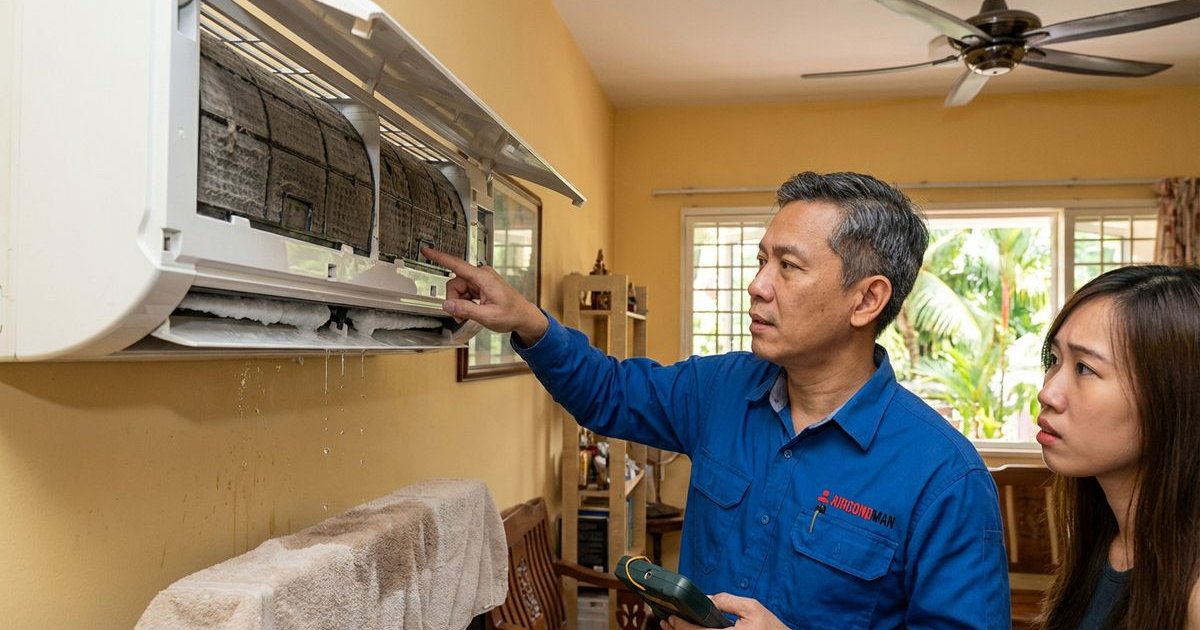
- Inspect the Filters: Open the front panel; if the mesh is grey with dust, airflow is blocked.
- Listen to the Outdoor Unit: You should hear the hum of the compressor, not just the fan blade spinning.
- Look for Error Codes: Check if the indoor unit is blinking or displaying a code like
E1orH6.
If these checks pass and the air is still warm, you are likely facing a mechanical issue.
Common Causes (From Most to Least Common)
1. Dirty Filters (Most Common)
The Answer: A clogged filter chokes the air intake, preventing the evaporator coil from absorbing heat effectively.
The Details: In Malaysia, dust mixes with humidity to form a sticky layer on your filters. If you live near a construction site or a busy road like the LDP or Federal Highway, this buildup happens twice as fast. When airflow drops, the cooling coil gets too cold and may freeze over, completely blocking the air.
Symptoms:
- Airflow from the vents feels weak or “breathless.”
- The room temperature drops very slowly.
- You hear a wheezing noise from the indoor unit.
- Ice starts forming on the copper pipes or the coil itself.
Actionable Tip:
Pro-Tip: For kitchen units, the “dust” is often mixed with cooking oil, creating a “gelatine” paste. You cannot just vacuum this; you must wash the filters with warm water and mild dish soap to cut the grease.
Cost: Free (DIY) | Time: 15 minutes
2. Dirty Evaporator/Condenser Coils
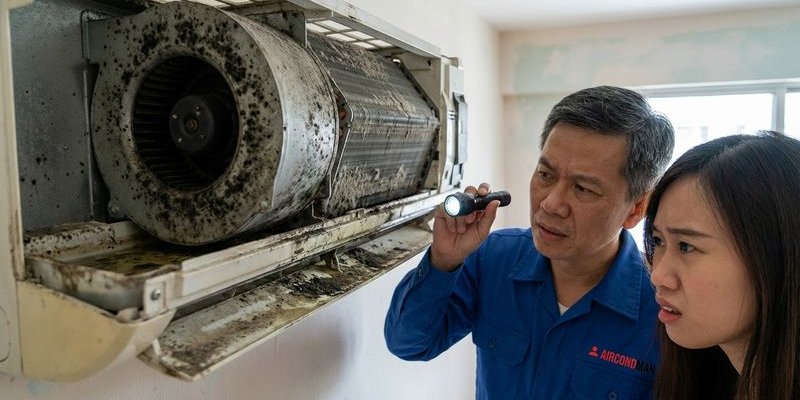
The Answer: Dust that bypasses the filters settles on the cooling fins, insulating them and preventing heat transfer.
The Details: While filters catch large particles, fine dust eventually coats the evaporator (indoor) and condenser (outdoor) coils. This acts like a blanket. A 2024 study by TNB suggests that dirty coils can increase electricity usage by up to 10% as the unit works harder to cool the same space.
Symptoms:
- Your electricity bill has gradually increased over the last 6 months.
- The air is cool but never truly cold.
- The unit runs non-stop without cutting off (non-inverter models).
- Musty or sour smell from the vents.
Solution:
- General Service: Uses water and pressure to clean light dust.
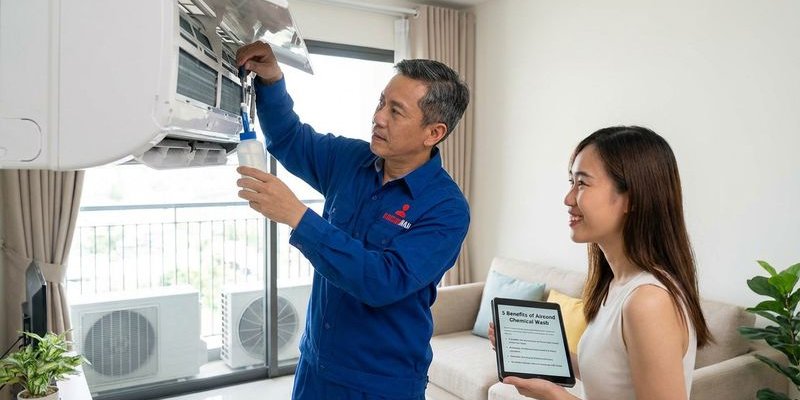
- Chemical Wash: Uses an alkaline solution to dissolve stubborn grime (recommended yearly).
- Chemical Overhaul: The unit is dismantled completely for a deep clean (for severe blockages).
Cost: RM120-180 (Chemical Wash) | Time: 1-2 hours
3. Low Refrigerant (Gas)
The Answer: Low gas pressure means there is not enough substance to carry heat out of your room, usually caused by a leak.
The Details: Refrigerant does not evaporate or get “used up” like petrol in a car. It is a closed loop. If your gas is low, you have a leak in the copper piping or flare nuts. In Malaysia, newer units use R32 gas, which is more efficient but operates at higher pressures than the older R410A or obsolete R22.
Symptoms:
- Ice on the thin copper pipe: This is the classic sign of low gas pressure.
- Hissing sound: A distinct hiss from the indoor unit often indicates an active leak.
- Warm breeze: The fan blows, but the air is room temperature.
Actionable Tip:
Warning: Do not just ask for a “top-up.” If you top up without finding the leak, the gas will escape again in a few weeks. Insist that the technician uses soapy water or a leak detector to find the source.
Cost: RM30-60 (Top-up R32) | RM150-400 (Leak Repair & Vacuum)
4. Blocked/Dirty Condenser (Outdoor Unit)
The Answer: The outdoor unit releases the heat absorbed from your room; if it is blocked, the heat stays inside.
The Details: This is common in Malaysian condos where outdoor units are stacked in small “air wells” or balconies. If the unit cannot breathe, it overheats and the compressor shuts down to protect itself (thermal overload). Pigeons nesting behind the unit are also a frequent culprit in urban areas like Kuala Lumpur and Penang.
Symptoms:
- The outdoor unit feels extremely hot to the touch.
- The compressor turns on for 5 minutes, then shuts off.
- Visible dirt, feathers, or leaves stuck in the back fins.
Solution:
- Clear any boxes, potted plants, or clothes drying racks from around the unit.
- Maintain at least 1 metre of clearance for airflow.
- Professional chemical cleaning for the outdoor fins.
Cost: Free (DIY clearing) or RM80-150 (Professional cleaning)
5. Compressor Issues
The Answer: The compressor is the engine of your aircond; if it fails, the refrigerant stops moving and cooling stops immediately.
The Details: Compressors are robust but can fail due to overheating or electrical surges. In older “non-inverter” units, a hard start or loud buzzing often points to a failed capacitor (a cheap fix) rather than a dead compressor (an expensive fix). For modern “inverter” units, the compressor varies its speed; failure here is often linked to the main PCB board.
Symptoms:
- Loud grinding or rattling noise from the outdoor unit.
- The outdoor fan spins, but the compressor does not kick in.
- The circuit breaker trips the moment the outdoor unit turns on.
Cost: RM1,200-1,800+ (Compressor replacement) | RM100-200 (Capacitor only)
6. Thermostat/Sensor Problems
The Answer: A faulty thermistor sends incorrect temperature data to the computer, causing the unit to cut off prematurely.
The Details: The copper or resin sensor typically sits on the indoor coil. Over time, its resistance value drifts. The unit might “think” the room is 18°C when it is actually 28°C, so it stops cooling to save energy.
Symptoms:
- The unit cools for 10 minutes then stops, even though the room is hot.
- Cooling works on “Test Run” mode but not on normal settings.
- Strange cycling behavior where the fan speeds up and slows down randomly.
Cost: RM80-150 (Sensor replacement) | RM250-450 (PCB Board)
7. Electrical Issues
The Answer: Voltage fluctuations or pest damage can destroy the sensitive electronics that control your aircond.
The Details: Common house lizards (Cicak) seeking warmth often crawl into the outdoor unit’s Printed Circuit Board (PCB) and cause a short circuit. Additionally, lightning strikes common during Malaysia’s monsoon season can surge through the wiring, frying the control board.
Components that often fail:
- Capacitor: A battery-like tube that kickstarts the compressor.
- PCB Board: The brain of the unit (expensive to replace).
- Wiring: Burnt connections at the terminal block.
Solution:
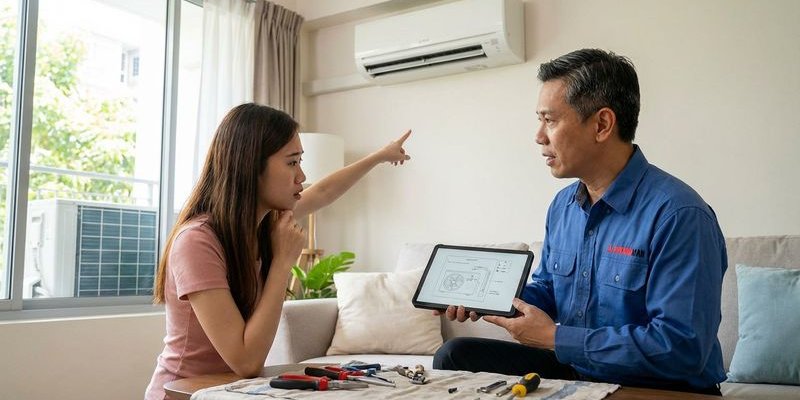
- Professional electrical diagnosis (multimeter check).
- Install a starter (magnetic contactor) if the switch melts often.
Cost: RM150-500 depending on component
8. Undersized Unit
The Answer: An undersized unit fights a losing battle against the heat load, running continuously without ever reaching the target temperature.
The Details: Developers sometimes install 1.0HP units in master bedrooms that actually require 1.5HP. In Malaysia, the standard calculation is Area (sq ft) x 75 BTU. A 200 sq ft master bedroom needs 15,000 BTU (1.5HP), not 9,000 BTU (1.0HP). If you live on the top floor directly under the roof, you need even more power.
Symptoms:
- The air coming out is cold, but the room stays warm.
- The unit never cuts off (compressor runs 100% of the time).
- The problem is worse on sunny afternoons but okay at night.
Solution:
- Add a second portable unit or wall fan to circulate air.
- Replace the unit with a higher horsepower model.
Note: No amount of gas or servicing will fix an undersized unit.
Diagnostic Summary
| Symptom | Likely Cause | Action |
|---|---|---|
| Weak airflow | Dirty filters or blower wheel | Clean filters or Chemical Wash |
| Ice on thin pipe | Low gas (Leak) | Leak check & Top-up |
| Ice on thick pipe | Dirty Indoor Coil | Chemical Service |
| Compressor hums but won’t start | Faulty Capacitor | Replace Capacitor |
| Blinks & stops | Sensor or PCB fault | Professional Check |
| Trips electric breaker | Compressor/Short circuit | Professional Repair |
| Cold air, hot room | Undersized Unit | Install Fan or Upgrade |
DIY vs Professional
You can fix:
- Dirty Filters: Wash them yourself every 2 weeks.
- Wrong Settings: Reset the remote to “Cool” mode.
- Blocked Outdoor Unit: Clear leaves and boxes away from the fan.
Call a professional for:
- Chemical Cleaning: High-pressure water is needed to clear deep blockages.
- Gas Issues: Handling R32 or R410A requires pressure gauges and vacuum pumps.
- Electrical Work: Do not touch capacitors or PCBs; the voltage can be lethal.
- Water Leaks: Requires blowing out the drain pipe or adjusting the slope.
Cost to Fix Not-Cooling Issues (2025 Estimates)
| Issue | Repair Cost (MYR) | Notes |
|---|---|---|
| Dirty Filters | Free | DIY |
| Chemical Wash (Wall) | RM 120 - 150 | For 1.0 - 1.5HP units |
| Gas Top-up (R32) | RM 30 - 60 | If pressure is slightly low |
| Gas Full Refill (R32) | RM 180 - 250 | After repairing a leak |
| Capacitor | RM 120 - 180 | Quick fix for non-inverters |
| PCB Board Repair | RM 250 - 450 | Common for inverter units |
| Compressor | RM 1,200+ | Usually better to buy new |
Prevention Tips
Maintain your cooling efficiency with this schedule:
- Clean filters every 2 weeks: This simple habit prevents 50% of cooling issues.
- Schedule Chemical Service yearly: Even clean homes have micro-dust that coats the coils.
- Keep the outdoor unit shaded: Direct sunlight heats up the unit, making it work harder.
- Use “Cool” not “Dry”: Dry mode runs the compressor intermittently and may not cool a hot room effectively.
- Run it regularly: Seals can dry out and leak if the unit sits unused for months.
When to Replace vs Repair
Consider replacement if:
- Age: The unit is over 8-10 years old.
- Gas Type: It uses the obsolete R22 gas (expensive to refill).
- Cost Ratio: The repair quote is more than 40% of a new unit’s price (e.g., RM600 repair vs RM1,500 new).
- Efficiency: Your electricity bill is consistently high despite servicing.
Aircond not cooling and need help? Contact Aircond Man for professional diagnosis - RM75 diagnostic fee waived if you proceed with repair.