“Your aircond needs a gas top-up.”
You hear this phrase often during routine service visits.
But is it actually true?
For most Malaysian homeowners, this single sentence leads to unnecessary spending.
The reality is that your air conditioner is a sealed system, much like your refrigerator. It does not consume gas to generate cooling.
If your gas level is low, there is a leak.
This guide explains the specific pressure readings (PSI) you need to know, the fair market price for services in Malaysia, and how to spot the difference between a genuine leak and a dirty filter.
The Big Truth About Refrigerant Gas
Many people believe aircond gas runs out like petrol in a car.
This is false.
Your air conditioner operates on a closed-loop system. The refrigerant circulates continuously between the indoor and outdoor units. It absorbs heat from your room and releases it outside.
During this process, the gas is not consumed, burned, or evaporated.
The 10-Year Rule: If your system is perfectly installed with high-quality copper piping, you might not need a gas top-up for 10 years or more. A drop in gas pressure always indicates a breach in this closed loop.
When You Genuinely Need Gas
You only need to add refrigerant in three specific scenarios.
1. Physical Leaks in the System
Corrosion is the enemy of copper pipes, especially in humid Malaysian weather.
Acidic rain or simple wear and tear can create microscopic holes in the piping or the condenser coil.
Common causes include:
- Vibration cracks: The outdoor unit vibrates during operation, which can loosen joints over time.
- Corrosion: Blue or green oxidation marks on copper pipes often signal a slow leak.
- Accidental punctures: Nails or drilling near concealed piping.
2. Post-Repair Refilling
If a technician replaces a major component like the compressor or the copper piping itself, they must refill the gas.
However, be careful during a “Chemical Overhaul.”
A skilled technician will perform a “pump down” before taking your unit down for a chemical wash. This process traps the gas in the outdoor compressor so it isn’t lost. You should not pay for a full refill after a standard chemical cleaning unless a leak was fixed simultaneously.
3. Installation Errors
New units should not leak.
If your brand-new aircond (less than 1 year old) is low on gas, the installer likely made a mistake.
The most common issue is poor flaring. This is where the copper pipe connects to the unit. If the flare connection is not tight or the angle is wrong, gas will escape slowly over the first few months.
Signs of Genuinely Low Gas
Low gas creates specific symptoms that look different from a dirty unit.
| Symptom | The Technical Reality |
|---|---|
| Warm Air | The fan blows strong, but the air is room temperature. |
| Ice on Thin Pipe | The smaller copper pipe at the outdoor unit turns white with frost. |
| Constant Running | The compressor never cuts off because it cannot reach the set temperature. |
| Hissing Sound | You hear a faint hissing noise near the indoor unit (active leaking). |
Pro Tip: If you see ice on the thick insulated pipe or the indoor coil itself, this is often a sign of a dirty unit (lack of airflow), not low gas.
When You DON’T Need Gas
Technicians may suggest a top-up when the real problem is maintenance.
The “Dirty Unit” Illusion
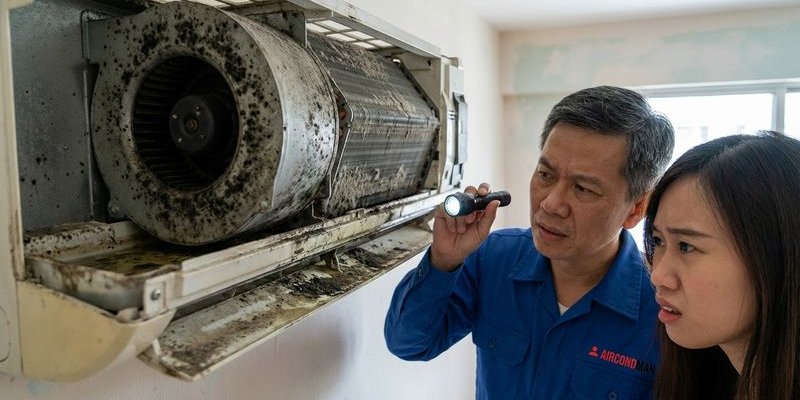
When your filters or evaporator coils are clogged with dust, the air cannot pass through efficiently.
This confuses the system. The pressure drops, and cooling performance suffers. A dishonest technician might show you a low pressure reading and blame the gas.
In reality, once you clean the unit, the pressure returns to normal naturally.
Red Flags to Watch For
Be cautious if you encounter these situations:
- The “Routine” Top-Up: The provider claims you need a “little bit” of gas every 6 months.
- No Pressure Check: They suggest gas without connecting a gauge to the outdoor unit.
- The “Unlimited” Promo: Ads on social media offering “Service + Free Gas” often use cheap, mixed refrigerants or underfill the unit.
- Vague Explanations: The technician cannot point out where the leak is.
How Professionals Check Gas Level
You can verify the diagnosis yourself by looking at the pressure gauge.
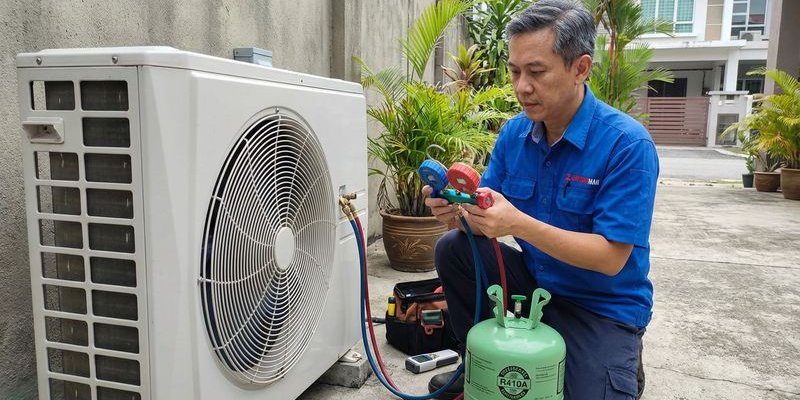
A professional uses a manifold gauge set connected to the service port on the outdoor unit. They look at the PSI (Pounds per Square Inch).
Standard Operating Pressures (Approximate):
- R22 Gas: 60 - 75 PSI
- R410A Gas: 110 - 130 PSI
- R32 Gas: 120 - 140 PSI
Note: These numbers vary based on the ambient temperature. On a hot afternoon (35°C), the pressure will naturally read higher.
If your R32 unit reads 130 PSI, and the technician says “it’s low,” ask them to explain why. That reading is typically within the healthy range.
Types of Refrigerant Gas in Malaysia
Knowing your gas type helps you avoid overpaying. You can find this information on the sticker on your outdoor unit.
R22 (The Old Standard)
- Status: Being phased out by the Department of Environment (DOE).
- Cost: Expensive. Since production is limited, the price of R22 rises every year.
- Equipment: Found in units older than 2015-2016.
R410A (The Transitional Gas)
- Status: Still common but being replaced by R32.
- Cost: Moderate.
- Performance: Operates at higher pressures than R22.
R32 (The Modern Standard)
- Status: The current standard for brands like Daikin, Panasonic, and Acson.
- Cost: Efficient and affordable.
- Benefit: It has a lower Global Warming Potential (GWP) and transfers heat more efficiently, saving electricity.
Warning: Never mix gases. You cannot top up an R22 unit with R32. The oils are incompatible and will destroy the compressor.
Gas Top-Up Pricing Guide (2025 Estimates)
Prices in the Klang Valley and major cities vary, but these ranges help you spot a rip-off.
| Service Type | Typical Price Range (MYR) |
|---|---|
| R22 Top-Up (Partial) | RM30 - RM60 |
| R410A / R32 Top-Up | RM40 - RM90 |
| R22 Full Refill (Empty) | RM180 - RM250 |
| R410A / R32 Full Refill | RM220 - RM300 |
| Leak Detection | RM50 - RM80 (Often waived if you repair) |
If Gas Keeps Running Low
Refilling a leaking unit is like pumping air into a punctured tyre. It works for a few days, then fails again.
The “Top-Up Trap” Math: If you pay RM80 for a top-up every 4 months, you spend RM240 a year.
A proper leak repair (welding or joint fix) might cost RM150 to RM250 once. Fixing the leak is cheaper than ignoring it.
Where Leaks Usually Hide:
- Flare Nuts: The connection points at the indoor and outdoor units.
- Service Valves: The ports where technicians connect their gauges.
- U-Bends: The curved copper sections on the condenser coil.
What Happens If You Ignore Low Gas?
Running an aircond with low refrigerant causes more damage than just a warm room.
- Compressor Overheating: The refrigerant cools the compressor. Without it, the compressor runs hot and eventually seizes up.
- High Electricity Bills: The unit runs non-stop, trying to reach a temperature it physically cannot achieve.
- Coil Corrosion: Constant freezing and thawing on the coils can accelerate rust and damage the fins.
How to Protect Yourself
Follow this checklist before you approve any additional charges.
The Smart Owner’s Protocol:
- Ask for the PSI: “Show me the gauge reading before and after.”
- Verify the Leak: “If the gas is low, where is the leak coming from?”
- Check the Soap: Ask them to put soapy water on the valves. If it bubbles, you have confirmed the leak yourself.
- Record History: Write down the date of your last gas top-up. If it was recent, you need a repair, not a refill.
Our Honest Approach
At Aircond Man, we prioritize data over guesswork.
We connect our gauges first to confirm the exact pressure. We show you the reading so you see exactly what we see.
If your system is healthy, we will not sell you gas.
If your system is leaking, we recommend finding the leak rather than wasting your money on a temporary refill. We document our findings to help you make the right decision for your home.
Summary
| Situation | Action Plan |
|---|---|
| First-time low gas (Old unit) | A top-up is a reasonable first step. Monitor it. |
| Recurring low gas (Every few months) | Stop topping up. Pay for leak detection and repair. |
| Technician says “Gas needed” instantly | Red flag. Ask for a pressure check first. |
| Unit not cooling + No ice | Likely dirty coils. Request a chemical wash. |
| Ice on thin copper pipe | High probability of low gas/leak. |
Need honest gas diagnosis? Contact Aircond Man - we check properly and only recommend what you need.